
The investor must know three things about themselves

'We are cautious only on sub-sectors that have seen massive melt-up during the past six months.'
Tightening financial conditions have set the stage for early Fed easing. Outside the US, there is no longer expectation of the ECB, BoJ, BoE, and BoC to hike rates this year again

According to the report, financial assets of the Indian households are predominantly in the form of bank deposits, followed by life insurance - a pattern that got disrupted after note ban
The government would take a number of steps to energise and deepen the country's corporate bond as well as currency derivatives market.

So far in 2019, India has been one of the highest recipients of foreign flows among Asian and Emerging Market (EM) economies

If Sebi and RBI remain quiet about this brazenly illegal activity, will someone in the finance ministry or the NITI Aayog take a closer look, asks Debashis Basu.

Billionaire Gautam Adani-led promoter group has paid off all of the $2.15 billion loans taken pledging their shares in the conglomerate, and only debt at operating company level remains, Adani Group said seeking to assure investors of its ability to repay debt. Adani Group in a statement termed reports of the group not completing repayment of $2.15 billion share-backed debt "baseless and deliberately mischievous." "Adani has completed full prepayment of margin linked share-backed financing aggregating to $2.15 billion (as was announced on March 12) and all corresponding shares pledged for those facilities have been released," it said.

Reddy has worked to reform the economy.

RBI Governor Shaktikanta Das kept the red flag on cryptocurrencies flying, warning that the next financial crisis can be triggered by private cryptocurrencies if such speculative instruments are allowed to grow.
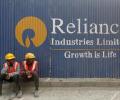
The rating affirmation reflected RIL's strong business profile - a large-scale refinery with a capacity of around 1.2 million barrels a day and dominant market position in petrochemicals.

Report says stressed asset level to peak at 15% in 2014-15.

Gold, forex assets, IT sector, pharma. Devangshu Datta explains why each of these is a good hedge against market shocks at this time.

Equity benchmark index Sensex buckled under selling pressure for the second straight session to close below the 65k mark on Friday, as investors offloaded IT, teck and metal stocks amid a bearish global trend. Besides, fresh foreign fund outflows also hit investor sentiments, traders said. In a volatile trade, the 30-share BSE Sensex declined 202.36 points or 0.31 per cent to settle at 64,948.66.

The federal agency said it conducted raids against a director of Zanmai Lab Pvt Ltd, which owns WazirX, on August 3 in Hyderabad and alleged he was "non-cooperative". The agency's probe against the crypto exchange is linked to its ongoing investigation against a number of Chinese loan apps (mobile applications) working in India.

The rupee on Friday rebounded from the near-80 levels to close higher by 17 paise at 79.82 against the US currency following a recovery in the domestic stocks and weakness in the greenback in overseas markets. The US dollar retreated from the two-decade high levels against a basket of six currencies which supported the rupee sentiment. At the interbank foreign exchange market, the local currency opened at 79.95 and witnessed an intra-day high of 79.82 and a low of 79.96 against the US dollar in the day trade. ,

By diversifying into developed market equities, Indian investors can mitigate the impact of cyclicality in returns as well as reduce currency risk, experts tell Sanjay Kumar Singh.

Continuing their massive selling spree for the ninth consecutive month, foreign investors dumped Indian shares worth Rs 50,203 crore in June -- the highest net outflow in over two years -- amid aggressive rate hike by the US Federal Reserve, elevated inflation and relatively higher valuation of domestic equities. Foreign portfolio investors (FPIs) have now pulled out around Rs 2.2 lakh crore from domestic equities in the first six months of 2022 -- the highest-ever net withdrawal by them. Before that, FPIs withdrew Rs 52,987 crore in the entire 2008, data with depositories showed.

India needs to move towards full capital account convertibility to become a leading global economy.

'... as has been happening in the last three weeks, then the foreign exchange reserves will not be comfortable to ensure that the rupee does not fall drastically.'

IndusInd Bank was the biggest loser in the Sensex pack, shedding 7.46 per cent, followed by SBI, Tata Motors, M&M, Bajaj Finserv, Axis Bank and Infosys. In contrast, Tech Mahindra was the only winner.

The rupee rose by 12 paise to close at 79.78 against the US dollar on Monday due to a weak dollar in overseas markets and an improved appetite for riskier assets. Stronger regional currencies also supported the rupee sentiment ahead of the US Fed policy decision on Wednesday. Weak domestic equities and FII outflows, however, capped sharp gains. At the inter-bank forex market, the local unit opened at 79.86 against the greenback and moved in a range of 79.70 to 79.87 in the day trade.

Banking and telecom will see the highest impact of this transition.

The department apparently suspects the use of shell firms or front entities in some aspects of such remittance. Money might, it suspects, have moved in some cases from tax-free jurisdictions or tax havens to accounts in the UAE and some South Asian countries.

"I am an academic and I have always made it clear that my ultimate home is in the realm of ideas," Rajan said in a letter to staff.
Govt to introduce comprehensive law on black money

In yet another move to close the regulatory gap between banks and shadow banks, the Reserve Bank of India (RBI) has mandated exposure limits to the non-banking finance companies, in line with commercial banks. In the large exposure framework released on Tuesday, the regulator capped aggregrate exposure of NBFCs which are in the upper layer toward one entity at 20 per cent of capital base. The limit can only be extended by another 5% with board's approval. For a particular borrower group, the cap is at 25 per cent, with additional 10 per cent if exposure is towards infrastructure.

Need for much more investment; sector would like govt help

China represents the "largest threat" to Britain and the world's security and prosperity this century and there is evidence to suggest it has targeted countries from the US to India, UK prime ministerial candidate Rishi Sunak said on Monday.

Urals and Sokol accounted for every 4 out of 5 barrels of Russian supplies to India last year.

The US Fed on May 24 hinted at withdrawing its third round of quantitative easing, or bond buying programme, worth $85 billion each month, which began in the wake of the worst credit crisis in September 2008.

The state-owned bank's loss largely offsets the Rs 1,800-crore (Rs 18-billion) capital injection the government will make in FY14.

Overall forex market sentiment suffered a sudden reversal of fortune contrary to expectation largely moving in line with local equities, reversing all early strong gains.

The central bank dashed hopes of any steep interest rate reduction.

The rupee depreciation will work in favour of students who are currently studying in the US and plan to secure a job that pays in dollars.

A whirlwind trip of the dark underbelly of global finance, covering everything from tax law changes to aiding criminals to decamp with money from bank accounts.

Apart from sustaining your portfolio when the domestic market is faring well, global diversification also safeguards it against currency risk.

Despite mounting pressure, Gotabaya, and Prime Minister Mahinda have refused to quit office.

A freely convertible country must have sound macroeconomic policies.

If your children live abroad, rely more on financial assets as they are easier to liquidate and move across borders.
